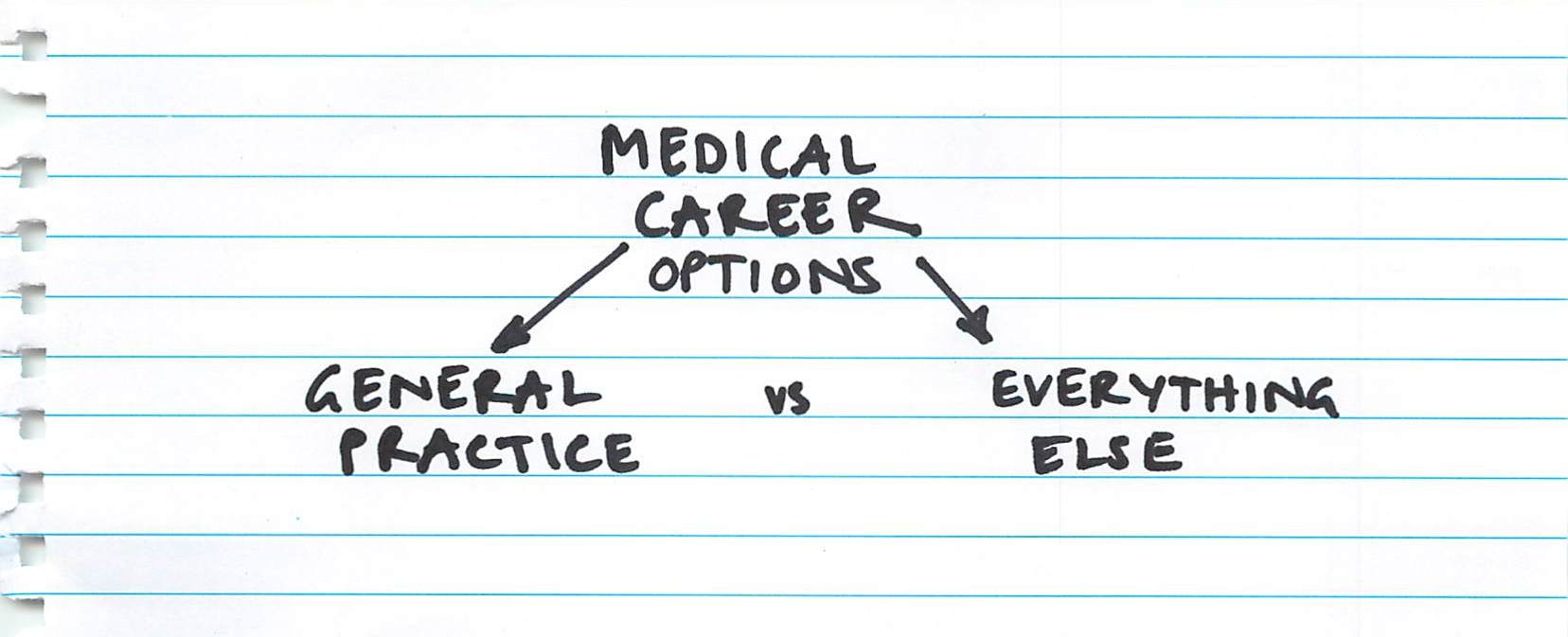
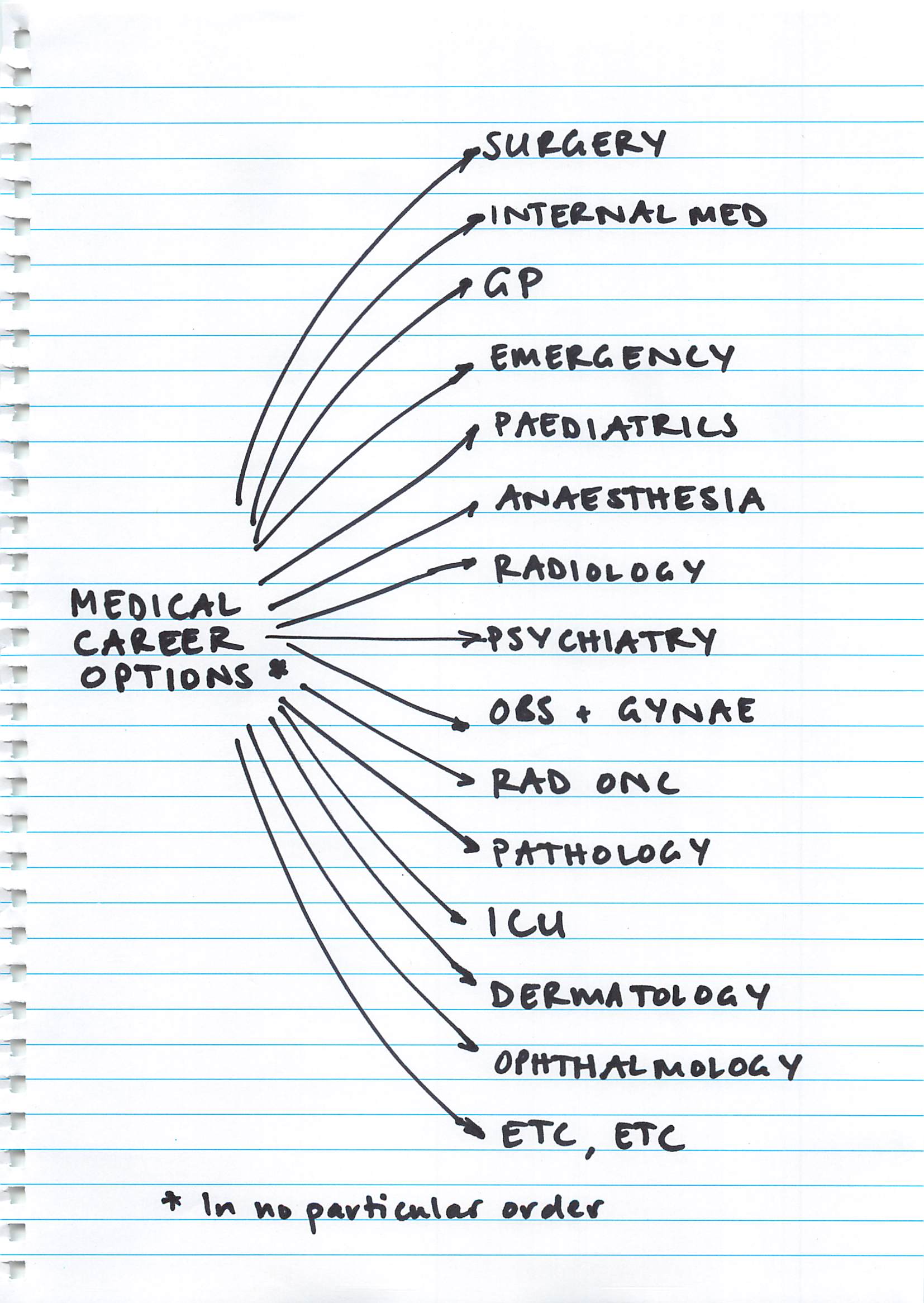
This is a question that Jeremy has had to answer a few times, and he gets a little frustrated. I came across this blog post, and it seems to outline all the reasons why this question could be irritating and a little insulting!
From http://nomadicgp.wordpress.com/2013/09/16/are-you-going-to-be-a-specialist-or-just-a-gp/
“Are you going to be a specialist? Or just a GP?”
As a medical student and junior doctor in my hospital training years,
I was often asked this question by friends, senior doctors and well
meaning patients. It really grated on me, that one little word: “just”.
I always thought I’d become a GP. As a teenager, I was inspired to
study medicine by my own GP who had always looked after my family with
such care and compassion. As I went through my training I dabbled with
the idea of other specialties; I was fascinating by the life stories of
my geriatric patients, I loved the cute-factor of paediatrics, I was
hooked on the emotional highs and lows of obstetrics, I enjoyed the team
atmosphere of the emergency department. But I think, deep down, that I
always knew I liked ALL of medicine too much and that above all I wanted
to make a meaningful difference to my patients’ lives. For me, GP was
the obvious choice.
Nowadays, when I tell people that I’m a GP, they ask instead “So are
you going to specialise in anything?” They don’t seem to understand that
I HAVE already specialised. I’ve specialised in General Practice (and
GP obstetrics) by doing an additional 4 years of training on top of my
medical degree and internship. I am officially registered with the
Australian Medical Board as a “Specialist General Practitioner”. This
has been a conscious decision; I haven’t just become a GP by default.
So to be asked these sorts of questions always seems so unfair. It
implies that ”GP” and “specialist” are two diametrically opposed
alternatives, and that GP is the lessor of the two. If you’re smart,
ambitious, passionate and successful you become a specialist. If you
can’t get into anything else or if you want the easy option you become a
GP. It’s seen as a back-up option, not as a worthwhile career in
itself.
The specialist vs “just a GP” dichotomy also perpetuates the idea
that GPs are not “experts” in their own right; that GPs are the amateur
doctors that do the easy bits of all the other specialties and then
refer on when it gets too complicated.
I’d like to dispel that myth. GPs ARE experts. We are the expert in each and every one of our patients.
We are also the experts in:
- Preventative medicine
- Undifferentiated illness
- Chronic disease management
- Complex multi-comorbidity
- Judicious use of finite medical resources
- Coordination of the health care team
We do these things better than anyone else. In fact, studies (see
here and
here)
have repeatedly demonstrated that an increasing number of primary care
doctors results in better health outcomes overall, a higher quality of
health service and at a decreased cost. Whereas an increasing number of
specialists is associated with higher costs and poorer quality of care,
including
higher overall mortality. So, as a group, GPs do a far better job at improving health outcomes and for less cost compared to specialists.
So where do all these negative attitudes come from? Unfortunately
some hospital doctors perpetuate these views. They refer to General
Practice dismissively as “coughs, colds and sore holes” or (particularly
for female GPs) “tears and smears”. I have heard some specialists
loudly criticise GPs for not knowing everything that they know about
their chosen field, apparently unable to appreciate the enormous breadth
of knowledge they have in other areas.
Once I even heard my university professor talk to our class about a
high achieving doctor that he had gone through med school with, saying
“She
had so much potential, she could have been a professor of medicine. It
was such a waste that she chose a career in General Practice”.
Even though the overwhelming majority of health care happens in the
primary health care sector, the lion’s share of university and junior
doctor teaching is done in hospitals by specialists, so it’s hardly
surprising that many of our hospital counterparts have such inaccurate
views of General Practice.
Admittedly, not all GPs are great teachers, and a GP rotation spent
sitting in a corner of a consulting room is not likely to leave a good
impression on the student. The subtleties and intricacies of a GP
consult are not well appreciated by watching (or snoozing) in the
background. Perhaps, as teachers, we could be doing better.
Here’s the thing. Any doctor who thinks that General Practice is easy has clearly never tried it themselves.
The reality is that General Practice is an enormously rewarding,
challenging and varied career and that no two days are ever the same. We
have no idea what is going to walk through our door next and it could
be anything from an infant with a fever, a pregnant lady with
pre-eclampsia, an elderly patient with new onset AF, a young man
suffering with crippling anxiety, a parent grieving the death of a child
to a full-blown heart attack. And all of these medical conditions come
with added layers of complexity from the patient’s personality factors,
social circumstances, family situation, expectations, medical
co-morbidities, values and beliefs.
Many of us have also chosen to pursue further training in
sub-specialised areas, eg obstetrics, anaesthetics, surgery, emergency
medicine, aboriginal health, dermatology, paediatrics, sexual health,
addiction medicine, medical education and many more. I may be in the
clinic one day, and the next be performing an emergency caesarean
section, or resuscitating a newborn. Really, the depth and breadth of
work that we can pursue as GPs is unrivaled – and we are incredibly
lucky in this respect.
So not only do we have to be able to initially manage every single
symptom and medical condition imaginable, we have to be able to do it
without a full suite of investigation tools, without easy access to
allied health and other specialists and all within an allocated time
slot of 10-15 minutes. What’s more we are not managing that patient
just for that episode of illness (or until we can turf them to another
team), rather we are caring for their overall health and well being in
the short, medium and longer term.
Don’t get me wrong. I have a huge appreciation for my specialist (?
partialist) colleagues. In particular I am grateful for the depth of
knowledge and skills that they have in their niche area that I could
never hope to achieve. I know that they, too, want the best outcomes for
our patients and that the system works best when we all work together.
However, I’d really like for people to stop asking “are you going to
be a specialist, or just a GP?” and instead to enquire “What type of
doctor are you going to be?”. It’s up to all of us to change the
conversation and give General Practice the respect and prestige it
deserves, so that medical career choices can be seen to be more like
this:
There is reason for optimism. The
General Practice Student Network has
over 60% of medical students as members and is doing great work to be a
shining light of General Practice amidst the loud voices of hospital
medicine. Also, applications to
Australian General Practice Training are
becoming more and more competitive. This year there were over 2000
applicants for only 1200 training places and eventually this will help
to change the perception of GP as an easy back-up option if Plan A
doesn’t work out.
The growing online presence of passionate GPs on social media can
only help to spread the word about what we believe is the best job in
the world. Check out blog posts from
notjustagp.com,
kidocs.org and
greengp.wordpress.com
on what they love about General Practice. For those of us who supervise
medical students, we have the perfect opportunity to share our passion
with the next generation by getting them involved in not just watching,
but
doing. I encourage you to let them sit in the big chair, and seat yourself in the corner so you can learn something from them, too.
To my patients: I know you may never understand the intricacies of
medical training, but I want you to know that out of all the career
paths on offer, I chose to be your GP; to be the person that you turn to
in your time of need, to see you as a whole person and not just a
diseased organ, and to be the one who helps guide you to health and
wellness. I hope you know that I feel truly privileged to be your
doctor.
In answer to the original question, no I’m not “just” a GP. I’m a
broadly-skilled, sub-specialised, expert GP, providing a damn fine
health service to my patients and my community. And I absolutely love
it.
.JPG)
.JPG)
.JPG)
.JPG)